Problem:
An Olympic-class sprinter starts a race with an acceleration of 4.50 m/s2.
(a) What is her speed 2.40 s later?
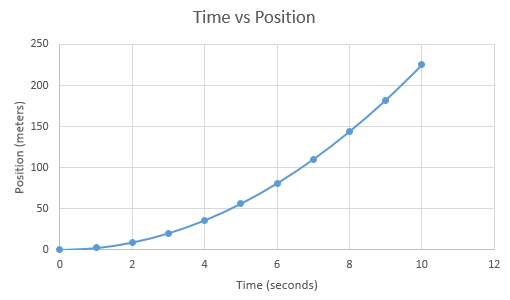
(b) Sketch a graph of her position vs. time for this period.
Solution:
We are given \overline{a}=4.50\:\text{m/s}^2, \ \Delta t=2.40\:\sec ,\:\text{and}\: v_0=0\:\text{m/s}
Part A
The unknown is v_f. The formula in solving for v_f is
v_f=v_0+at
Substituting the given values,
\begin{align*}
v_f & =0\:\text{m/s}+\left(4.50\:\text{m/s}^2\right)\left(2.40\:\text{s}\right) \\
v_f & = 108\:\text{m/s} \ \qquad \ \color{DarkOrange} \left( \text{Answer} \right)
\end{align*}
Part B
The relationship between position and time can be calculated using the formula
x=v_0t+\frac{1}{2}at^2Then, with the given, we can express position in terms of time
\begin{align*}
x & =0+\frac{1}{2}\left(4.50\:\text{m/s}^2\right)\left(\text{t}^2\right) \\
x & =2.25\text{t}^2 \\
\end{align*}
The values of the position given the time are tabulated below
| Time (seconds) | Position (meters) |
|---|---|
| 1 | 2.25 |
| 2 | 9.00 |
| 3 | 20.25 |
| 4 | 36.00 |
| 5 | 56.25 |
| 6 | 81.00 |
| 7 | 110.25 |
| 8 | 144.00 |
| 9 | 182.25 |
| 10 | 225.00 |
The values are plotted in the coordinate axes
College Physics Chapter 2 Problems

College Physics 2nd Edition Solutions Table of Contents
Chapter 1: Introduction: The Nature of Science and Physics
Chapter 3: Two-Dimensional Kinematics
Chapter 4: Dynamics: Force and Newton’s Law of Motion
Chapter 5: Further Applications of Newton’s Laws: Friction, Drag, and Elasticity
Chapter 6: Uniform Circular Motion and Gravitation
Chapter 7: Work, Energy, and Energy Resources
Chapter 8: Linear Momentum and Collisions
Chapter 10: Rotational Motion and Angular Momentum
Chapter 12: Fluid Dynamics and Its Biological and Medical Applications
Chapter 13: Temperature, Kinetic Theory, and the Gas Laws
Chapter 14: Heat and Heat Transfer Methods
Chapter 15: Thermodynamics
Chapter 16: Oscillatory Motion and Waves
Chapter 17: Physics of Hearing
Chapter 18: Electric Charge and Electric Field
Chapter 19: Electric Potential and Electric Field
Chapter 20:
Electric Current, Resistance, and Ohm’s Law
Chapter 21: Circuits and DC Instruments
Chapter 22: Magnetism
Chapter 23: Electromagnetic Induction, AC Circuits, and Electrical Technologies
Chapter 24: Electromagnetic Waves
Chapter 25: Geometric Optics
Chapter 26: Vision and Optical Instrument
Chapter 27: Wave Optics
Chapter 28: Special Relativity
Chapter 29: Introduction to Quantum Physics
Chapter 30: Atomic Physics
Chapter 31: Radioactivity and Nuclear Physics
Chapter 32: Medical Applications of Nuclear Physics
Chapter 33: Particle Physics
Chapter 34: Frontiers of Physics
You must be logged in to post a comment.