Problem:
While entering a freeway, a car accelerates from rest at a rate of 2.40 m/s2 for 12.0 s.
(a) Draw a sketch of the situation.
(b) List the knowns in this problem.
(c) How far does the car travel in those 12.0 s? To solve this part, first identify the unknown, and then discuss how you chose the appropriate equation to solve for it. After choosing the equation, show your steps in solving for the unknown, check your units, and discuss whether the answer is reasonable.
(d) What is the car’s final velocity? Solve for this unknown in the same manner as in part (c), showing all steps explicitly.
Solution:
Part A
The sketch of the situation is shown below. Also, the knowns and unknowns are in the illustration.
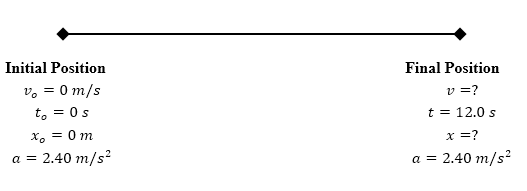
From the illustration above, we can see that the initial velocity is 0 m/s, the initial time and initial distance are also zero. The final velocity and the final distance are unknowns. The time at the final location is 12 seconds and the acceleration is constant all throughout the trip at 2.40 meters per second square.
Part B
The knowns are: a=2.40\:\text{m/s}^2; t=12.0\:\sec; v_0=0\:\text{m/s}; and x_0=0\:\text{m}
Part C
For this part, the unknown is the value of x. If we examine the equations for constant acceleration and the given values in this problem, we can readily use the formula x=x_0+v_0 t+\frac{1}{2}at ^2. That is
\begin{align*}
x & =x_0+v_0 t+\frac{1}{2}at^2 \\
x & =0\:\text{m}+\left(0\:\text{m/s}\right)\left(12.0\:\text{s}\right)+\frac{1}{2}\left(2.40\:\text{m/s}^2\right)\left(12.0\:\text{s}\right)^2 \\
x & =172.8\:\text{m} \ \qquad \ \color{DarkOrange} \left( \text{Answer} \right)\\
\end{align*}
Part D
For this part, the unknown is the value of v. The equation that can be used based from the known variables is v=v_0+at. That is
\begin{align*}
v & =v_0+at \\
v & =0\:\text{m/s}+\left(2.40\:\text{m/s}^2\right)\left(12.0\:\text{s}\right) \\
v & =28.8\:\text{m/s} \ \qquad \ \color{DarkOrange} \left( \text{Answer} \right)
\end{align*}
College Physics Chapter 2 Problems

College Physics 2nd Edition Solutions Table of Contents
Chapter 1: Introduction: The Nature of Science and Physics
Chapter 3: Two-Dimensional Kinematics
Chapter 4: Dynamics: Force and Newton’s Law of Motion
Chapter 5: Further Applications of Newton’s Laws: Friction, Drag, and Elasticity
Chapter 6: Uniform Circular Motion and Gravitation
Chapter 7: Work, Energy, and Energy Resources
Chapter 8: Linear Momentum and Collisions
Chapter 10: Rotational Motion and Angular Momentum
Chapter 12: Fluid Dynamics and Its Biological and Medical Applications
Chapter 13: Temperature, Kinetic Theory, and the Gas Laws
Chapter 14: Heat and Heat Transfer Methods
Chapter 15: Thermodynamics
Chapter 16: Oscillatory Motion and Waves
Chapter 17: Physics of Hearing
Chapter 18: Electric Charge and Electric Field
Chapter 19: Electric Potential and Electric Field
Chapter 20:
Electric Current, Resistance, and Ohm’s Law
Chapter 21: Circuits and DC Instruments
Chapter 22: Magnetism
Chapter 23: Electromagnetic Induction, AC Circuits, and Electrical Technologies
Chapter 24: Electromagnetic Waves
Chapter 25: Geometric Optics
Chapter 26: Vision and Optical Instrument
Chapter 27: Wave Optics
Chapter 28: Special Relativity
Chapter 29: Introduction to Quantum Physics
Chapter 30: Atomic Physics
Chapter 31: Radioactivity and Nuclear Physics
Chapter 32: Medical Applications of Nuclear Physics
Chapter 33: Particle Physics
Chapter 34: Frontiers of Physics
You must be logged in to post a comment.