Problem:
Show that the order of addition of three vectors does not affect their sum. Show this property by choosing any three vectors A, B, and C, all having different lengths and directions. Find the sum A + B + C then find their sum when added in a different order and show the result is the same. (There are five other orders in which A, B, and C can be added; choose only one.)
Solution:
Consider the three vectors shown in the figures below:
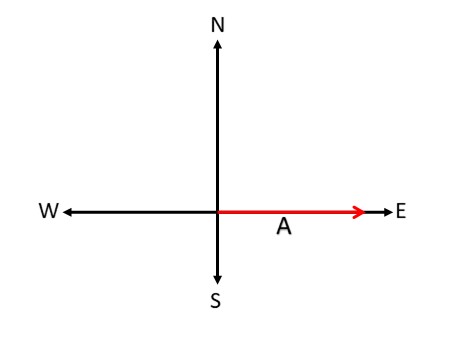
Vector A
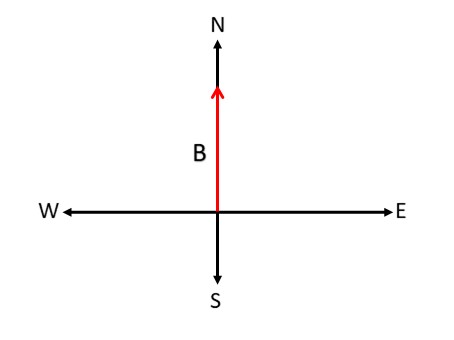
Vector B
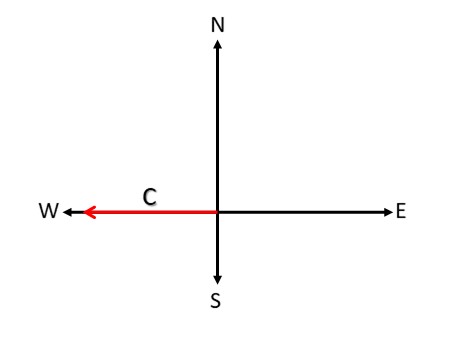
Vector C
First, we shall add them A+B+C. Using the head-tail or graphical method of vector addition, we have the figure shown below.

Now, let us try to find the sum of the three vectors by reordering vectors A, B, and C. Let us try to find the sum of C+B+A in that order. The result is shown below.

We can see that the resultant is the same directed from the origin upward. This proves that the resultant must be the same even if the vectors are added in different order.
College Physics Chapter 3 Problems

College Physics 2nd Edition Solutions Table of Contents
Chapter 1: Introduction: The Nature of Science and Physics
Chapter 3: Two-Dimensional Kinematics
Chapter 4: Dynamics: Force and Newton’s Law of Motion
Chapter 5: Further Applications of Newton’s Laws: Friction, Drag, and Elasticity
Chapter 6: Uniform Circular Motion and Gravitation
Chapter 7: Work, Energy, and Energy Resources
Chapter 8: Linear Momentum and Collisions
Chapter 10: Rotational Motion and Angular Momentum
Chapter 12: Fluid Dynamics and Its Biological and Medical Applications
Chapter 13: Temperature, Kinetic Theory, and the Gas Laws
Chapter 14: Heat and Heat Transfer Methods
Chapter 15: Thermodynamics
Chapter 16: Oscillatory Motion and Waves
Chapter 17: Physics of Hearing
Chapter 18: Electric Charge and Electric Field
Chapter 19: Electric Potential and Electric Field
Chapter 20:
Electric Current, Resistance, and Ohm’s Law
Chapter 21: Circuits and DC Instruments
Chapter 22: Magnetism
Chapter 23: Electromagnetic Induction, AC Circuits, and Electrical Technologies
Chapter 24: Electromagnetic Waves
Chapter 25: Geometric Optics
Chapter 26: Vision and Optical Instrument
Chapter 27: Wave Optics
Chapter 28: Special Relativity
Chapter 29: Introduction to Quantum Physics
Chapter 30: Atomic Physics
Chapter 31: Radioactivity and Nuclear Physics
Chapter 32: Medical Applications of Nuclear Physics
Chapter 33: Particle Physics
Chapter 34: Frontiers of Physics
You must be logged in to post a comment.